Flatbed Towing in Calgary
Flatbed towing loads your entire vehicle onto a trailer deck, keeping all four wheels off the road for the trip. Here's when it's the right choice and why.
What Flatbed Towing Is
A flatbed tow truck carries a hydraulic trailer deck that tilts down to ground level, allowing a vehicle to be driven or winched onto it before the deck levels out for transport. Unlike wheel-lift towing, none of the vehicle's wheels touch the road at any point during the tow.
This matters because some vehicles and situations aren't well suited to having only part of the vehicle rolling on its own wheels. Below are the main reasons flatbed towing tends to be the more appropriate option.
Why Keeping All Four Wheels Off the Road Can Matter
All-wheel-drive and four-wheel-drive systems are generally designed to have all wheels turning together, driven by the vehicle's engine. When a wheel-lift truck partially tows a vehicle, some of those wheels remain in contact with the road and can turn independently of what the drivetrain expects, which is why flatbed towing is commonly recommended for AWD and 4WD vehicles.
Driveline, transmission and axle issues can be made worse by towing a vehicle with any wheels touching the ground, since the problem component may still be engaged during the tow.
Accident-damaged vehicles may have bent wheels, damaged suspension, or steering that no longer tracks straight. Loading the vehicle fully onto a flatbed avoids relying on the vehicle's own wheels and steering to roll during transport.
Flatbed towing isn't automatically required in every situation — a standard front-wheel-drive car with no mechanical issues can often be towed safely with wheel-lift equipment. But for the situations above, flatbed towing is often the more appropriate way to move a vehicle without adding further damage.
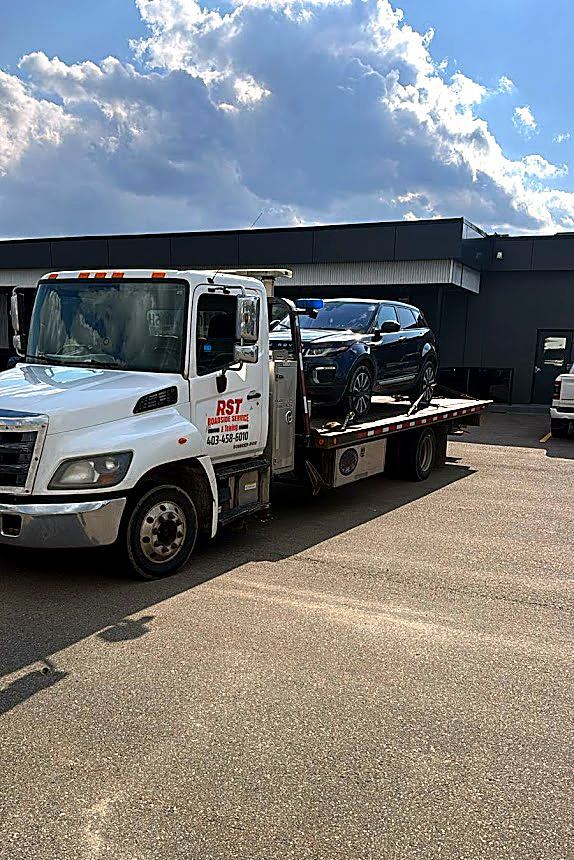 Flatbed Towing
Vehicles That Commonly Use Flatbed Towing
- All-wheel-drive and four-wheel-drive vehicles
- Vehicles with driveline, transmission or axle problems
- Vehicles damaged in a collision
- Low-clearance or modified vehicles
- Vehicle transport where the car won't be driven at pickup or drop-off
- Motorcycles and other vehicles that can't be wheel-lifted safely
Need a Flatbed Tow?
If your vehicle is AWD/4WD, has a drivetrain issue, or was in a collision, let the dispatcher know when you call. It helps us send a flatbed truck from the start.
Call (403) 458-6010Need a Flatbed Tow?
Call (403) 458-6010 and mention your vehicle's drivetrain or the damage involved.
Available Throughout
Frequently Asked Questions
Is flatbed towing always required for AWD vehicles?
It's the generally recommended option for most AWD/4WD vehicles to avoid drivetrain strain, though the appropriate method can vary by vehicle. Mention your make and model when you call and we can advise.
Does flatbed towing cost more than wheel-lift towing?
Cost can vary by situation. Call and describe your vehicle and location, and we can talk through what's involved before dispatching a truck.
Can a flatbed tow a vehicle that doesn't run at all?
Yes — a non-running vehicle can be winched onto the deck, so it doesn't need to be driven on or off.
Do you use flatbed trucks for accident towing?
Yes, flatbed towing is commonly used for accident-damaged vehicles, particularly when steering or suspension may be affected.